BORN FROM THE PACIFIC The Stunning Truth Behind Melanesia’s Natural Blondes
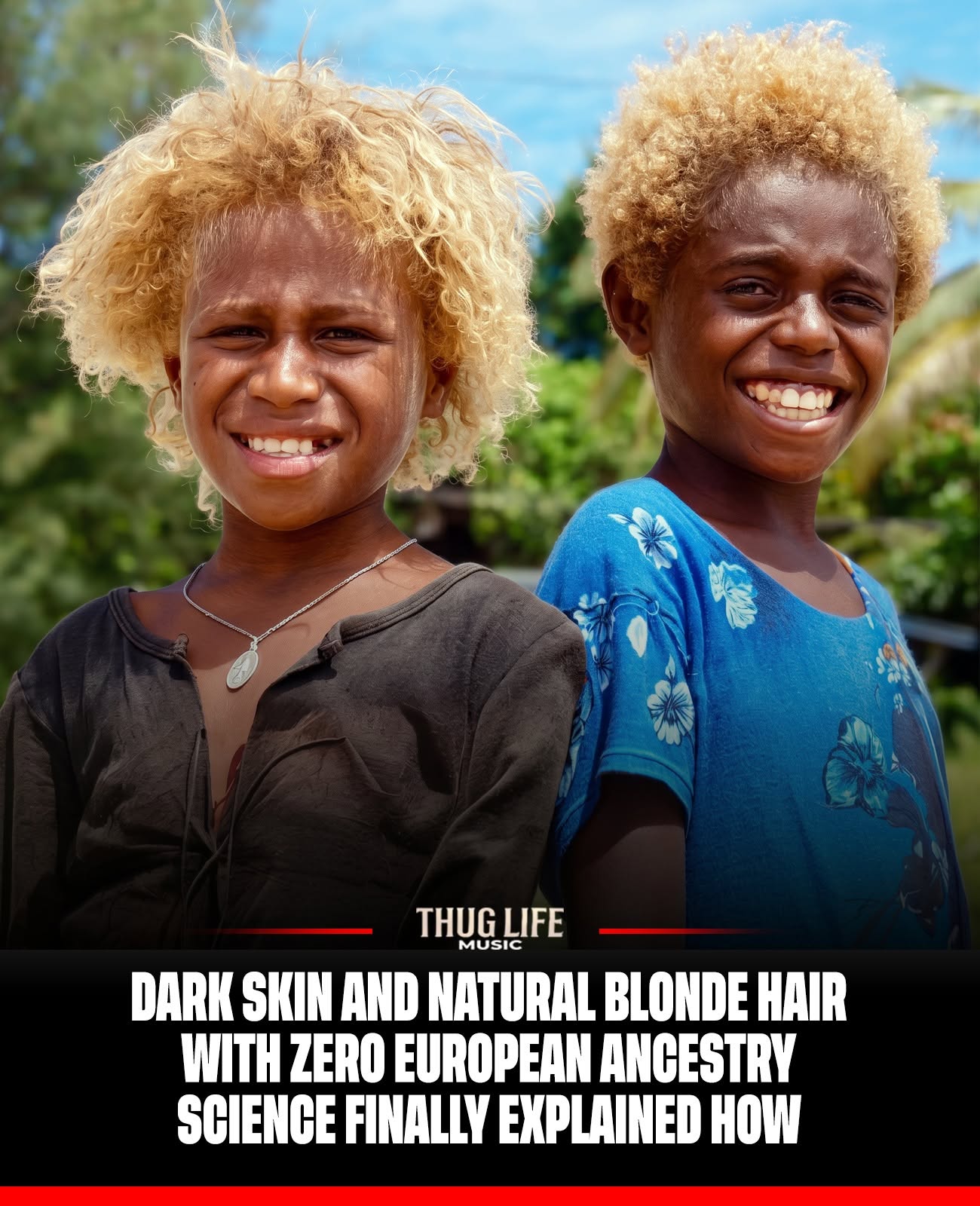
Dark skin. Bright blonde hair. No European ancestry. For decades, the world thought it knew the explanation. Science revealed a far more fascinating story.
For generations, travelers arriving in the islands of Melanesia were stunned by what they saw. Children with deep brown skin running along tropical shores, their heads crowned with striking golden-blonde hair.
To outsiders, the assumption seemed obvious. Blonde hair was associated with Europe, so many concluded that the trait must have come from European explorers, traders, or settlers who had passed through the Pacific centuries ago.
The theory was repeated so often that it became accepted as fact.
But it was wrong.
In 2012, researchers published a groundbreaking study that challenged everything people thought they knew about blonde hair in Melanesia. After analyzing the DNA of island populations, scientists discovered that the blonde hair seen in many Melanesians was not inherited from Europeans at all.
Instead, it came from a unique genetic mutation that developed independently within the population itself.
The discovery stunned the scientific community.
Nature’s Own Blueprint
The research identified a variation in a gene called TYRP1, which plays a role in pigmentation. This specific mutation reduces pigment production in hair, creating the distinctive blonde color seen throughout parts of Melanesia.
What makes the finding remarkable is that the mutation is different from the genetic changes responsible for blonde hair in Europeans.
In other words, two populations on opposite sides of the world arrived at a similar appearance through completely different genetic pathways.
It’s one of the clearest examples of convergent evolution in human genetics—where nature independently produces similar traits without a shared origin.
A Trait Found Nowhere Else
The blonde-hair mutation is particularly common in some Melanesian communities, appearing in roughly one out of every four people.
Despite centuries of migration and human movement across the globe, researchers found that this genetic variation is largely unique to Melanesian populations.
It is not a borrowed trait.
It is not the result of outside influence.
It is a naturally occurring characteristic that emerged within the islands themselves.
Challenging Assumptions
The story serves as a reminder of how easily appearances can mislead us.
For years, people looked at blonde hair and assumed they understood its history. Yet genetics revealed a much deeper truth: similar features do not always come from the same ancestors.
Human diversity is far more complex—and far more fascinating—than simple stereotypes suggest.
The blonde children of Melanesia are living proof that nature often writes the same story in different ways.
More Than Hair
Beyond the science, there is something profoundly beautiful about the discovery.
It reminds us that uniqueness does not always come from inheritance. Sometimes it emerges naturally, unexpectedly, and entirely on its own.
Across thousands of miles and countless generations, nature created two shades of blonde hair through two completely separate journeys.
The color may look the same.
The story behind it could not be more different.
Some beauty isn’t inherited from anyone. It’s created from scratch.