
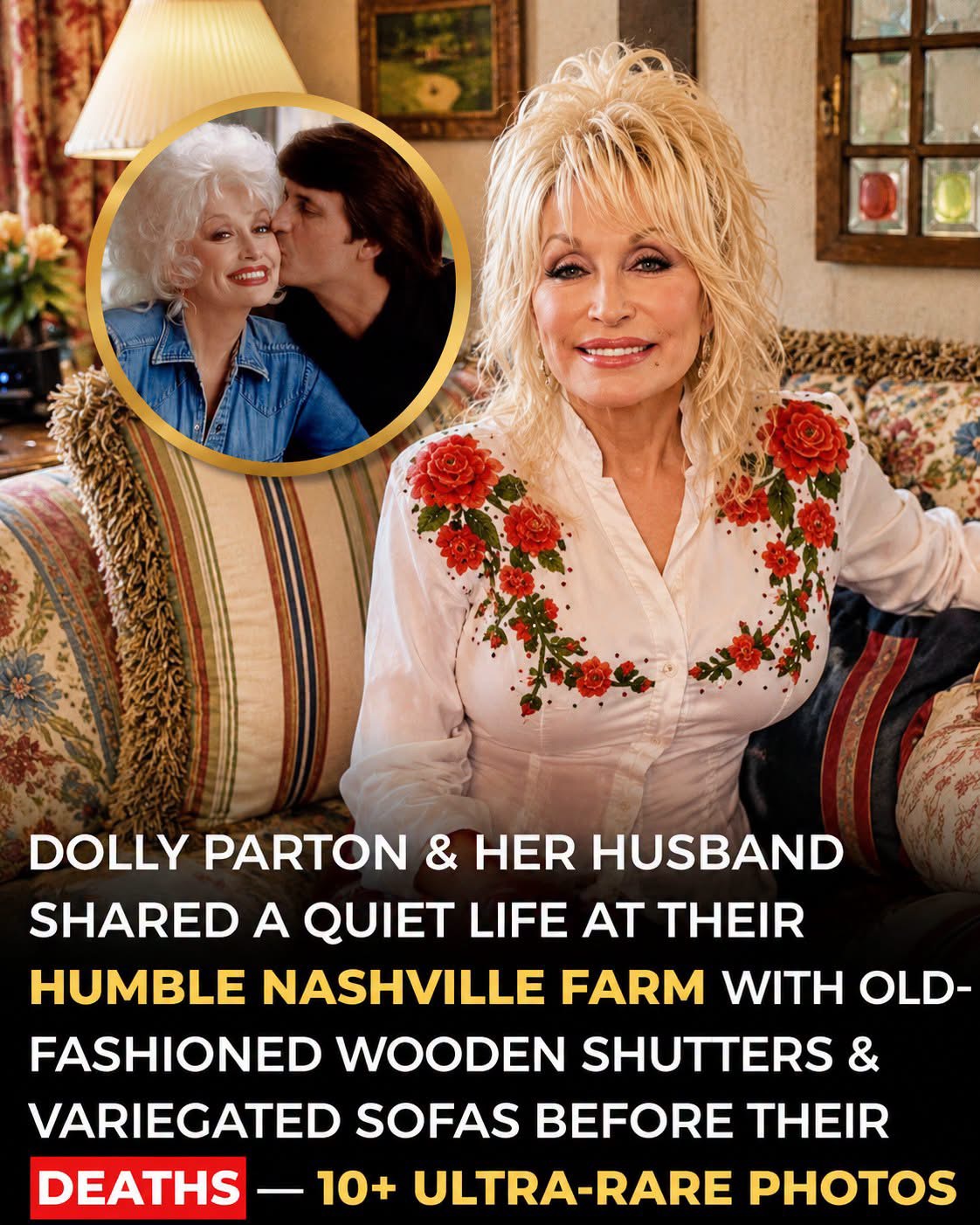
Away From the Spotlight, Dolly Parton and Her Husband Enjoyed a Quiet Life on Their Cozy Farm
Dolly Parton spent most of her adult life as one of the most recognizable performers in the world, yet the person at the center of her private life remained almost completely outside the celebrity world. Carl Thomas Dean, the man she married before her career reached its extraordinary heights, avoided cameras, red carpets, interviews, and most public appearances. Their relationship lasted from May 30, 1966, until Dean’s death on March 3, 2025, giving the couple nearly 59 years of marriage.
Throughout that time, Parton repeatedly explained that their unusual ability to maintain both togetherness and independence helped protect the relationship. Their story became one of the most enduring marriages associated with modern entertainment, precisely because so much of it happened away from entertainment itself. The couple’s story began in Nashville in 1964, on the first day Parton arrived in the city to pursue a professional music career.
She was 18 years old and had recently graduated from high school in East Tennessee. Dean was 21. Their first encounter took place outside the Wishy Washy Laundromat, a location that would later become an unexpectedly famous part of Parton’s biography. She recalled being struck by the fact that Dean seemed genuinely interested in talking with her rather than being distracted by her appearance. Two young people who could not have known what the coming decades would bring had begun a relationship almost immediately after Parton’s arrival in Music City.
Parton was already determined to build a songwriting and singing career. Her move to Nashville had been motivated by ambition rather than romance, and marriage was not necessarily the first item on her plans. Dean, meanwhile, was a Nashville-area businessman who had no desire to become part of show business. Those contrasting personalities would later become one of the defining features of their marriage. Parton pursued increasingly public dreams, while Dean found satisfaction in a much quieter life. Rather than forcing one another into the same world, they eventually learned to allow both lives to exist side by side.
They dated for approximately two years before getting married. On May 30, 1966, Parton and Dean traveled to Ringgold, Georgia, with Parton’s mother, Avie Lee. The wedding was deliberately small. According to Parton’s official website, the only people present besides the bride and groom were Avie Lee, the minister, and the minister’s wife. It was Memorial Day, and there was none of the spectacle one might associate with the wedding of someone who would eventually become an international superstar. At that moment, Parton’s enormous future fame was still ahead of her.
Parton was 20 when she married Dean, while he was 23. This detail is occasionally reported incorrectly because the ages at which they met—18 and 21—are sometimes confused with their ages at the wedding two years later. The distinction matters in an accurate account of their relationship. Their marriage began before Parton became nationally famous through The Porter Wagoner Show and before songs such as “Jolene,” “I Will Always Love You,” and “9 to 5” turned her into one of country music’s defining figures.
The contrast between Parton’s career and Dean’s personality soon became enormous. As Parton became increasingly famous, Dean became increasingly determined to remain private. He did not pursue celebrity opportunities through his wife and rarely appeared at entertainment-industry events. Parton repeatedly said that his lack of interest in fame was genuine rather than a publicity strategy. He had married her, she explained, not the business surrounding her. That distinction became an important rule in their life together.
Dean was so rarely seen publicly that Parton sometimes joked about people believing she had invented him. She explained that his absence from public events led some people to wonder whether he actually existed. Her response was straightforward: Dean was real, but he simply did not want a public life. Parton respected that preference and deliberately avoided pushing him into interviews or public appearances. She believed exposing him unnecessarily to celebrity attention would have taken away the peace he valued.
Parton described their arrangement as keeping their lives both separate and together. Dean understood that she had chosen an entertainment career, while he had chosen her rather than that industry. They could therefore have individual interests without interpreting independence as emotional distance. Parton traveled, recorded music, performed, acted, conducted interviews, and operated businesses. Dean maintained the far quieter lifestyle he preferred.
Parton often joked that one secret to their long marriage was simply not being together every minute. In interviews, she sometimes answered questions about marital longevity by saying she “stayed gone” or spent enough time traveling that they were not constantly in each other’s space. The remark was usually delivered humorously, but Parton said there was truth behind it. She believed independence helped them appreciate the periods when they were together rather than becoming overly dependent on constant proximity.
That independence did not mean they lacked common interests. Parton repeatedly described their sense of humor as one of the strongest elements of the marriage. She called Dean a good man with a deep personality and a particularly unusual sense of humor. He could make her laugh, and she appreciated that he felt secure enough in himself not to be threatened by her success.
Parton also described Dean as someone who understood that fame belonged to her professional life rather than their private relationship. He did not need to become famous because his wife was famous. He did not appear to measure himself against the enormous scale of her success. That security became particularly valuable as Parton’s career expanded beyond country music into television, movies, business, publishing, philanthropy, and international celebrity.
Their home life remained deliberately ordinary compared with Parton’s public image. Parton loved rhinestones, elaborate costumes, towering wigs, and theatrical performances, but she said that life with Dean could be remarkably simple. They enjoyed staying home, taking trips in a small camper or RV, eating together, and traveling without creating elaborate celebrity experiences.
Parton told interviewers that the couple enjoyed driving around in their camper and finding quiet places to stop. She sometimes packed food in a picnic basket and they would find a riverbank where they could eat together. On other occasions, they might stay in an inexpensive motel as long as it was clean and comfortable. These descriptions provide a sharp contrast with assumptions that every aspect of a superstar’s life must involve luxury.
Parton also enjoyed cooking for Dean. She spoke about preparing foods they both liked and sometimes turning an ordinary meal into a small romantic occasion. Instead of extravagant public celebrations, she could bring out cloth napkins, crystal, and good china at home. Her descriptions suggested that the ritual mattered more than the expense. They could transform something simple into a private date because the point was spending time together.
The couple also had a strong connection to Tennessee. Their primary home life remained near Nashville, far from the nonstop activity surrounding Parton’s professional schedule. In 1972, they bought property that eventually became a large private estate near Brentwood. The property gave them considerable privacy and became the home base around which much of their married life revolved.
Dean had his own business life. He operated an asphalt-paving business and later retired. Unlike Parton, he did not want to turn professional accomplishments into public identity. He preferred life around home, vehicles, equipment, and personal projects. This contributed to the longstanding public impression of him as mysterious, although Parton generally described the reality as much simpler: he was simply a private person.
That privacy also meant Dean rarely attended Parton’s major professional events. Even as she collected awards and reached career milestones, he generally stayed away from ceremonies. Parton never portrayed that absence as lack of support. Instead, she said Dean simply disliked the entertainment-industry environment. He could be proud of her without wanting to stand beside her on a red carpet.
Parton sometimes joked that Dean was not particularly interested in listening constantly to her music either. He loved her, but that did not mean he behaved like a fan. The distinction appears to have amused Parton rather than bothered her. For someone surrounded professionally by people praising her music, having a spouse whose role had nothing to do with celebrity admiration may have provided a useful sense of normality.
The couple did not have children. Parton spoke publicly about this many times over the years and did not present it as a hidden tragedy. She acknowledged occasionally wondering what motherhood might have been like, but she also came to believe that her life followed a different path. In later interviews, she said not having children gave her the freedom to dedicate enormous amounts of time to music, travel, work, philanthropy, and extended family.
Parton ultimately connected that part of her life with her broader relationship to children. She maintained close relationships with nieces, nephews, and her extended family and became famous for the Imagination Library, which provides books to children. She sometimes expressed the belief that perhaps she had not been meant to have children of her own because she was able to direct her energy toward many children instead.
Her answer was not intended as a universal judgment about parenthood. It was an explanation of how she understood her own circumstances. Parton knew that raising children would likely have affected the amount of traveling and professional commitment possible during the most intense decades of her career. She did not suggest that one life choice was better than another; she simply recognized how her own life developed.
Dean’s lack of jealousy also became something Parton valued strongly. Few spouses experience a situation in which their partner becomes internationally famous, works with major stars, travels continuously, and receives enormous public attention. Parton said Dean remained secure in himself and trusted her. She believed that quality was difficult to replace.
Their contrasting personalities actually became part of the attraction. Parton described herself as someone who constantly wanted to go somewhere, work, create, or experience something new. Dean was far more content staying close to home. Instead of treating those differences as incompatibility, they found a way to make them useful.
She could travel extensively without assuming Dean needed to accompany her.
He could enjoy privacy without expecting her to abandon her ambitions.
Then they could come back together when their schedules allowed.
That pattern continued for decades.
In 2016, Parton and Dean reached their 50th wedding anniversary, an achievement especially notable in the entertainment world. They decided to celebrate by renewing their wedding vows. Parton had previously said she wanted the kind of wedding dress she had not worn during their extremely simple 1966 ceremony, while Dean would have a suit.
The vow renewal gave them an opportunity to celebrate the marriage differently from their first wedding. After half a century together, they could look back on an extraordinary journey that neither could have anticipated in Ringgold. Parton’s career had expanded across music, film, television, business, amusement parks, publishing, and charity. Dean had remained the private man she met outside a laundromat.
The anniversary also generated some of the relatively rare photographs of Dean with his wife. Parton’s official website published images connected with the milestone, offering fans an unusual glimpse of the man who had intentionally remained outside the spotlight for decades.
Even these public glimpses did not lead Dean to become a celebrity personality. He continued maintaining the same approach that had defined most of the marriage. He did not begin giving regular interviews or appearing with Parton professionally.
For Parton, respecting that boundary was part of loving him.
She knew celebrity attention could be intrusive.
She had chosen a career where scrutiny was unavoidable.
Dean had not.
Keeping him away from unnecessary attention was therefore something she considered protective rather than secretive.
That boundary may also explain why the marriage became surrounded by rumors over the years. When people rarely see one spouse of a famous person, curiosity naturally increases. Parton answered such speculation with humor, but she never changed the basic arrangement simply to satisfy public curiosity.
The marriage belonged primarily to them.
The public career belonged to Parton.
That division remained remarkably consistent.
As the couple grew older, Parton began adjusting aspects of her professional schedule. In 2022, she said she did not expect to return to the kind of extensive full-scale touring she had done earlier in life. She still planned concerts and individual appearances, but the long touring schedules that required weeks away from home had become less appealing. Part of that decision involved wanting to remain closer to Dean as they both aged.
Parton understood how physically demanding touring could be. It required travel, preparation, performances, rehearsals, and long periods away. After decades of that lifestyle, staying closer to home increasingly mattered to her.
This did not mean she retired from music.
Far from it.
Parton continued recording, writing, appearing publicly, launching projects, and developing new work. The change concerned the structure of touring rather than her creative ambitions.
Her home life with Dean became increasingly important during those later years.
They had already spent decades balancing separation and togetherness.
Now the balance shifted somewhat toward home.
Dean’s health later became an important private concern. Parton continued protecting details about him rather than turning illness into public content. When he died on March 3, 2025, she announced the news while emphasizing the love they had shared over nearly six decades and requesting privacy. He was 82.
His death ended one of the longest marriages associated with a major entertainment figure.